
The Greyhound, often celebrated as the pinnacle of canine speed, combines elegance with explosive power in every stride. Originally bred as a sighthound for hunting and coursing, this remarkable dog has also made its mark in the world of racing, captivating enthusiasts with its unmatched agility and keen eyesight.
But how fast can a Greyhound truly run, and what makes it capable of such breathtaking bursts of speed? Join us as we explore the science, anatomy, and fascinating history behind the world’s fastest dog.
Greyhound Top Speed
When it comes to speed, Greyhounds are in a class of their own among domestic dogs. Known for their lean, aerodynamic build and powerful musculature, they are bred specifically for racing and coursing, making them the undisputed champions of canine sprinting. But exactly how fast is a Greyhound, and what factors contribute to their legendary pace?
1. Maximum Sprint Speed (The Record)
The widely accepted average top speed for a racing Greyhound is approximately 45 miles per hour (72 kilometers per hour). This speed represents the peak performance of healthy, fully trained Greyhounds in optimal conditions, and it firmly establishes them as the fastest dog breed in the world.
Beyond the average, anecdotal and unofficial reports have occasionally recorded Greyhounds reaching slightly higher velocities, up to 47 mph (76 km/h) in short bursts. These exceptional figures are rare and often come from elite racing dogs during highly competitive events. While such records may not be officially documented in every case, they highlight the remarkable potential of the breed when physiology, training, and motivation align perfectly.
2. Greyhound Speed in Race Conditions
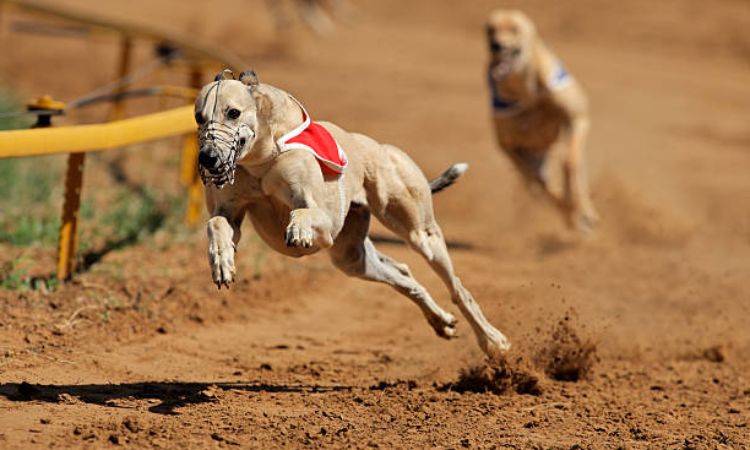
In actual race conditions, Greyhounds rarely maintain their absolute top speed for the entire course, but they still reach astonishing velocities. On average, they can sustain around 40 to 43 mph (64 to 69 km/h) over a standard racing distance of 500 to 600 yards (460 to 550 meters). What makes them especially impressive is not just the raw speed, but their incredible acceleration. Greyhounds can go from a standstill to near-top speed in just a few strides, showcasing the explosive power of their long, muscular legs and flexible spine.
This rapid acceleration is a defining characteristic of the breed. While a human sprinter like Usain Bolt may take several seconds to reach peak velocity, a Greyhound achieves its top pace almost immediately, thanks to a combination of lean muscle composition, efficient lung capacity, and an aerodynamic build designed for speed. Their ability to combine swift acceleration with sustained sprinting over several hundred meters makes them perfectly suited for racing, coursing, and other activities that test both speed and endurance.
Greyhounds are not just fast—they are engineered for performance. From the officially recorded 45 mph sprints to their rapid acceleration in competitive races, these dogs exemplify the extraordinary capabilities of selective breeding and natural athleticism in the canine world.
Why Are Greyhounds So Fast? A Marvel of Anatomy
Greyhounds are often celebrated as the Ferrari of the dog world, and their astonishing speed is no accident—it is the result of millions of years of evolution, selective breeding, and unique anatomical adaptations. Understanding why Greyhounds are so fast requires a closer look at their running style, body structure, and specialized physiology.
1. The Double Suspension Gallop
One of the most fascinating aspects of Greyhound locomotion is the double suspension gallop, a running gait unique to elite sprinters among canines. During this gait, all four of the Greyhound’s feet leave the ground twice in a single stride cycle, creating two “suspended” phases. This suspension allows the dog to cover more ground with each stride, increasing both stride length and overall speed. Essentially, it is a biomechanical design optimized for rapid acceleration and sustained sprinting.
The double suspension gallop is particularly effective because it allows Greyhounds to maintain a smooth, flowing motion while keeping the limbs free to move at high frequencies. This gait, combined with their long legs, contributes significantly to the Greyhound’s ability to reach top speeds of 45 mph (72 km/h), a pace unmatched by other dog breeds.

2. Specialized Body and Musculature
Greyhounds’ bodies are fine-tuned for speed, from organ function to skeletal flexibility and muscle composition:
- Large Heart and Lung Capacity: Greyhounds possess a deep chest that houses a disproportionately large heart and oversized lungs. These organs allow efficient oxygen delivery to muscles, supporting explosive bursts of speed and quick recovery during high-intensity running. Their cardiovascular system functions like a high-performance engine, fueling every stride with maximum energy.
- Flexible Spine: The Greyhound’s spine is extremely flexible, acting like a spring during running. With each stride, the spine extends and contracts, effectively lengthening their reach and increasing stride length. This spinal elasticity is crucial for both rapid acceleration and smooth, continuous motion at top speed.
- Muscle Composition: Greyhounds have a high proportion of fast-twitch muscle fibers, which are essential for short bursts of explosive energy. These fibers contract rapidly and powerfully, enabling the dog to accelerate from a standstill to top speed in mere seconds.
- Aerodynamic Build: Every part of the Greyhound’s body contributes to minimizing air resistance. Their slender, streamlined frame, narrow head, and short, thin coat allow them to slice through the air efficiently, reducing drag and conserving energy during a sprint.
3. The Foot Structure
Even the Greyhound’s feet are specialized for speed. Their arched toes and compact paw pads provide superior traction and shock absorption, reducing impact stress during high-speed running. This unique foot structure, combined with strong tendons and ligaments, ensures that Greyhounds maintain stability and balance while hitting incredible velocities.
Greyhound Speed Comparison Fastest on Land?
1. Greyhounds vs. Other Canines
Within the canine world, Greyhounds reign supreme. They can achieve top speeds of around 45 mph (72 km/h), outpacing other high-speed breeds such as the German Shepherd, which maxes out at about 30 mph (48 km/h), and the Border Collie, which reaches roughly 30-32 mph (48-51 km/h). Even other sighthounds like the Saluki and Afghan Hound, impressive runners in their own right, reach speeds of 42 mph (68 km/h) and 40 mph (64 km/h), respectively. Greyhounds’ extraordinary speed is a result of their unique combination of long legs, flexible spine, aerodynamic build, and muscular composition, which together create the ultimate sprinting machine among domestic dogs.
2. Greyhounds vs. Humans (Usain Bolt)
When compared to humans, Greyhounds leave even the fastest athletes in the dust. Usain Bolt, the fastest recorded human sprinter, reached a top speed of 27.8 mph (44.7 km/h) during his 100-meter world record. That is significantly slower than a Greyhound, which can reach 45 mph (72 km/h). To put it in perspective, a Greyhound could cover the same distance Bolt sprints in just a fraction of the time, making these dogs virtually untouchable in a straight-line sprint against humans. While humans rely on endurance over distance, Greyhounds combine both top-end speed and a surprising ability to sustain fast runs for up to 273 yards (250 meters) at peak speed, which makes them not just sprinters, but long-distance racers compared to cheetahs.
3. Greyhounds vs. Other Land Animals (The Real Sprinters)
In the broader animal kingdom, Greyhounds are fast but not the fastest. The cheetah, for instance, is unmatched in short-distance sprints, capable of reaching speeds of 60–75 mph (97–120 km/h). However, cheetahs can only maintain these bursts for about 200 meters (219 yards) before overheating and requiring rest, while Greyhounds’ superior endurance allows them to sustain high speeds over longer distances, making them remarkable long-distance sprinters relative to other animals.
Other notable land sprinters include the pronghorn antelope, capable of 55 mph (88 km/h) over longer distances, lions, which can reach 50 mph (80 km/h) in short chases, and horses, which can sprint around 55 mph (88 km/h) under ideal conditions. While these animals may surpass Greyhounds in peak speed, few domestic animals combine high velocity with endurance as effectively as Greyhounds, solidifying their title as the fastest dog and one of the fastest sustained land runners in the animal world.
Greyhound Endurance
Sprinter, Not Marathoner
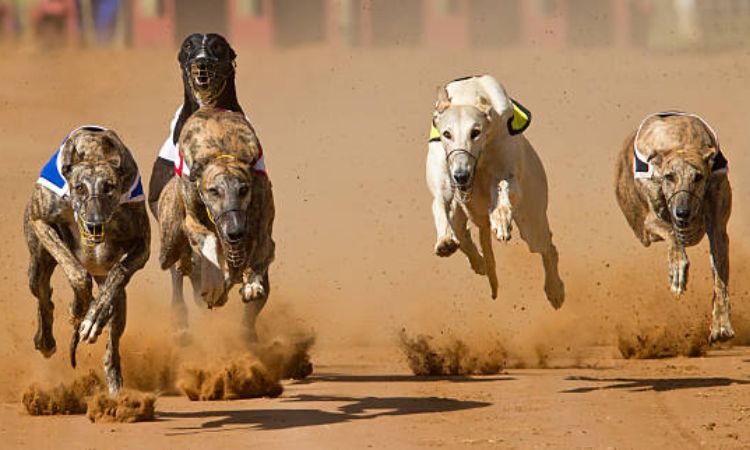
Greyhounds are built for speed, not distance. As a breed, they were originally developed for coursing and racing, which require short-to-medium distance sprints rather than long endurance runs. At their peak, Greyhounds can reach speeds of up to 45 mph (72 km/h), but they can only sustain near-top speeds for roughly 250–275 yards (230–250 meters). Beyond this distance, their sprinting efficiency drops rapidly, which is why these dogs excel in racing or chase games but are not suited for marathons or prolonged running sessions.
Endurance vs. Other Breeds
While Greyhounds are unmatched in sprinting, they don’t compare to true endurance breeds. Dogs like Siberian Huskies and Alaskan Malamutes are built for stamina, capable of running long distances across harsh terrains at moderate speeds. These breeds rely on slow, steady energy output and endurance muscle fibers, whereas Greyhounds rely predominantly on fast-twitch muscles designed for explosive bursts. In practical terms, a Greyhound might outpace a Husky in a 100-meter dash, but in a 5–10 mile run, the Husky would easily take the lead.
The “45 MPH Couch Potato” Paradox
One of the most endearing and surprising traits of Greyhounds is their paradoxical lifestyle: they are elite sprinters, yet they often behave like “couch potatoes.” After short, intense bursts of exercise, they spend the majority of the day resting or sleeping, sometimes up to 18 hours a day. This combination of high-speed capability and low-energy downtime makes them unique among dog breeds—they are fast and athletic, but also incredibly calm and low-maintenance in a home environment. Their need for sprinting is brief but exhilarating, and once satisfied, they’re content to lounge for hours.
- You Might Also Be Interested In: How fast can a Whippet run